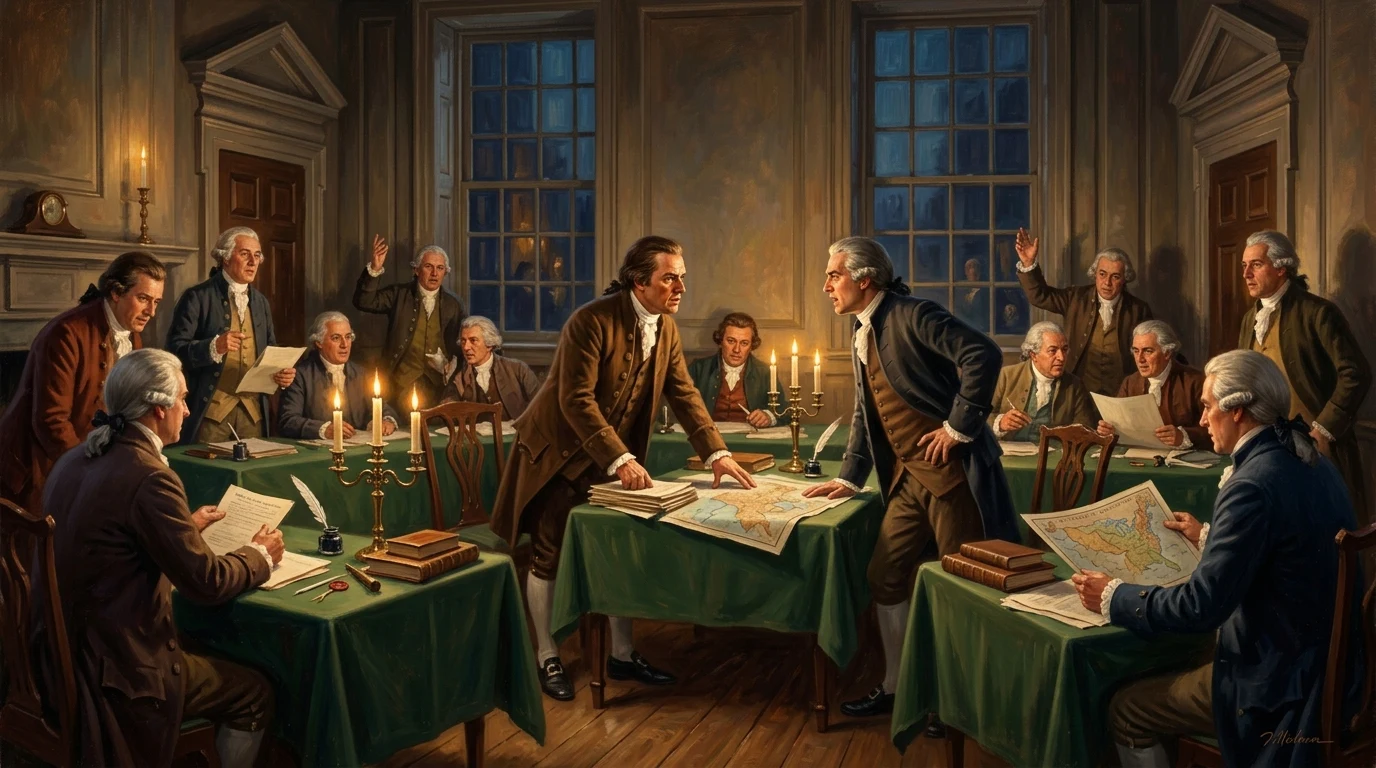
The Articles of Confederation usually arrives on the instructional calendar right after the high drama of the Revolutionary War. Students spend weeks following George Washington crossing the Delaware, winter at Valley Forge, and the climactic siege of Yorktown. Then, abruptly, the pacing hits a wall.
We ask twelve-year-olds to transition from military drama directly into unicameral legislatures, nine-of-thirteen supermajorities, and state tariff disputes. Attention evaporates almost immediately.
The traditional fix is a comparison chart or a graphic organizer listing governmental weaknesses: no executive branch, no national court system, and no power to levy taxes. Students dutifully copy these bullet points into their notebooks, memorize them for Friday’s quiz, and forget them by the following Tuesday. The problem is simple. To a middle school student, “Congress could not tax citizens directly” sounds like an abstract civics rule rather than an existential crisis.
The Operational Failure of Abstract Civics
Memorizing a list of weaknesses fails because students have no operational concept of state sovereignty. In 1783, citizens did not view themselves primarily as Americans. They viewed themselves as Virginians, Pennsylvanians, or New Yorkers. The national government was not an overarching authority; it was a fragile treaty organization between thirteen suspicious neighbors.
When we explain this theoretically, it rarely connects. When students experience the resulting friction directly, the entire historical problem snaps into focus.
A Fifteen-Minute Simulation: Experiencing the Gridlock
Before handing out any reading materials, try dividing the classroom into five distinct state delegations: Virginia, New York, Rhode Island, Pennsylvania, and Massachusetts. Give each state group a specific geographic identity and a set of competing priorities.
The mechanics take less than fifteen minutes to run:
- Issue Independent Currencies: Hand each state group a stack of paper currency stamped with their state name. Inform the class that neighboring states do not have to accept currency from outside their borders.
- Introduce a Trade Dispute: New York enacts a heavy tax on any agricultural goods arriving from New Jersey and Connecticut across the Hudson River. Rhode Island prints massive amounts of paper money to pay off local debts, causing rampant inflation that infuriates merchants in Boston.
- Present a Shared National Crisis: Announce that French and Dutch banks are demanding repayment for wartime loans, while Continental Army veterans are threatening revolt over unpaid wages. Congress needs fifty thousand dollars immediately.
- Call for a Voluntary Tax: Ask the delegates who is willing to contribute their state tax revenue to the national treasury to resolve the crisis.
Within five minutes, the room begins to unravel in a very predictable way. Virginia refuses to pay debts incurred by northern merchants. Rhode Island points out that their vote carries the exact same legal weight as Virginia’s, despite having a fraction of the population. New York and Massachusetts threaten retaliatory tariffs.
The exercise stops being a lesson on the 1780s. It becomes an immediate experience in how decentralized systems collapse when central authority lacks the power to enforce basic cooperation.
Bringing Primary Sources Into the Friction
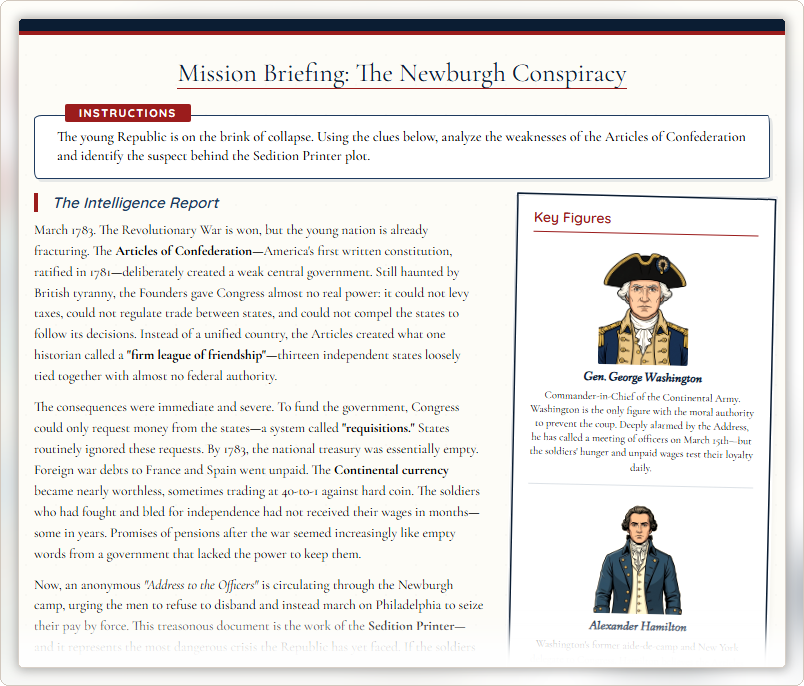
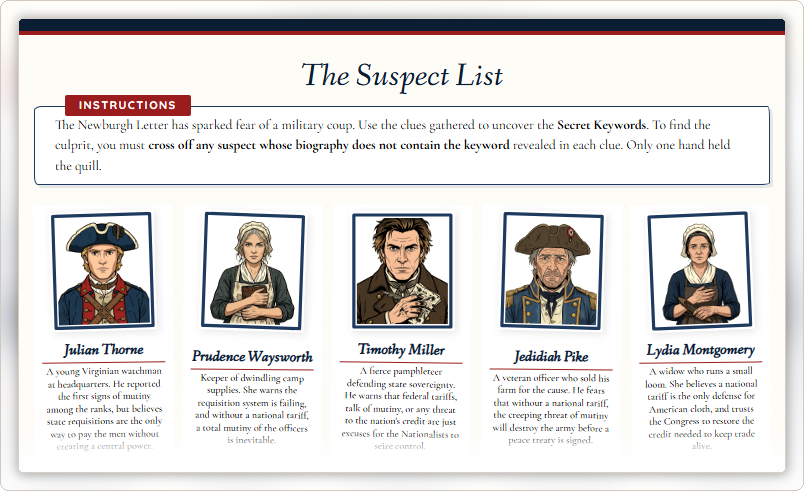
Once students feel that procedural frustration, historical documents read entirely differently. When we frame early American dilemmas as active investigations, such as our Articles of Confederation History Sparks Mystery, students step into the roles of delegates examining actual evidence rather than memorizing dry lists.
Instead of treating George Washington’s letters from Mount Vernon as exercises in decoding formal eighteenth-century prose, students examine them as urgent dispatches from a deeply worried observer. When Washington wrote that the confederation was “little more than a shadow without the substance,” students understand exactly what he meant. They just watched their own classroom confederation dissolve into the same deadlock.
The same reality applies to Shays’ Rebellion. When farmers in western Massachusetts shut down county courthouses to stop farm foreclosures, the inability of the national government to dispatch troops ceased to be an academic trivia question. Students recognize that the system had no enforcement mechanism to maintain domestic order.
The Instructional Takeaway
The transition to the Constitutional Convention in Philadelphia makes intuitive sense only after students experience why the original framework was fundamentally unsustainable.
When students participate in the structural dilemma first, they arrive at the solution on their own terms. By the time you introduce the Constitution, students are no longer asking why the delegates met behind closed doors in the summer of 1787. They already know.
Articles of Confederation | A History Sparks Mystery
Step into the 1783 Newburgh crisis with an engaging primary source investigation for grades 5–8. Students decode 5 historical clue cards, cross-examine delegate motives, and eliminate suspects to uncover the Sedition Printer before a military coup.
View on Teachers Pay Teachers