
Handing a seventh grader an unabridged excerpt from Thomas Paine, the Declaration of Independence, or a colonial petition is often an exercise in immediate cognitive overload.
Eighteenth-century syntax, nested dependent clauses, and archaic vocabulary create an intimidating barrier. Students hit words like usurpations, inestimable, or perfidy, lose the grammatical subject entirely, and give up before completing the opening paragraph.
A common reaction is to replace authentic historical documents with modern secondary summaries. While this speeds up pacing, it removes the foundational skill of disciplinary literacy: learning to evaluate evidence directly from historical actors. Middle schoolers do not need documents rewritten into modern slang; they need structured methods to break dense text into manageable cognitive units.
The Three-Sentence Rule
The primary reason students freeze when looking at historical documents is visual density. A wall of unbroken text printed in twelve-point font signals difficulty before reading even begins.
The simplest adjustment is enforcing the three-sentence rule:
- Isolate the Passage: Never present more than three sentences on a single task card or station sheet. White space on the page lowers anxiety and invites reading.
- Preserve the Authentic Voice: Keep the original eighteenth-century phrasing, but eliminate tangential clauses that distract from the central claim. Use clear ellipses so students understand that text has been condensed without altering the author’s meaning.
- Footnote Sparingly: Avoid cluttering the margin with ten dictionary definitions. Provide simple inline replacements in brackets for only the two or three archaic terms that obscure the core argument.
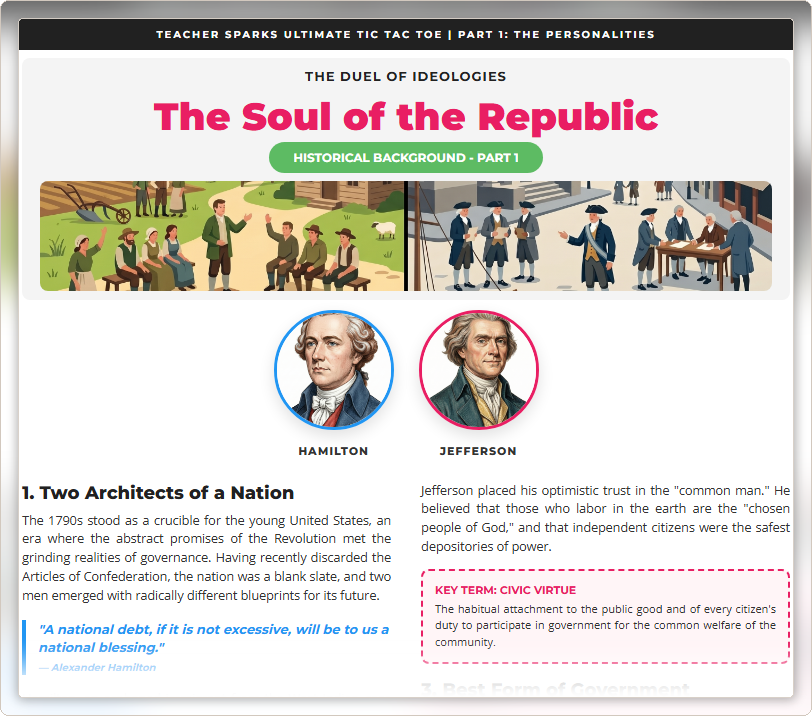
When a passage is confined to a tight, approachable visual space, striving readers no longer feel defeated before they read the first line. They can dedicate their working memory to untangling the sentence structure rather than managing visual exhaustion. We apply this exact scaffold in our Ultimate Tic-Tac-Toe: Hamilton vs. Jefferson Review Game, where contrasting viewpoints from early cabinet debates are presented in three-sentence source cards paired with targeted vocabulary callouts.
Sourcing Before Decoding
Middle school students reflexively jump into body paragraphs without glancing at the header or attribution. When reading historical texts, reading the content before establishing context is a recipe for confusion.
Before students read a single sentence of historical prose, require them to answer three preliminary sourcing questions:
- Who is speaking? What was their economic status, geographic location, or political affiliation?
- When was this written? What specific event happened right before this document was produced?
- Who was the intended audience? Is this a private diary entry, an anonymous political pamphlet, or a formal petition to a monarch?
Knowing that a text is an anonymous broadside printed in Boston during the 1774 military occupation changes how a student reads the opening sentence. Context provides an interpretive framework that helps readers predict vocabulary and tone before they begin decoding.
Headline Matching: Evaluating Claims Without Boring Worksheets
Standard comprehension worksheets often ask students to restate facts: “What three grievances are listed in paragraph two?” This prompts students to scan for capitalized words and copy sentences verbatim without understanding the underlying point.
A far more rigorous alternative is headline matching:
- Present students with a short three-sentence excerpt.
- Provide three competing modern newspaper headlines below the passage: one that accurately captures the central claim, one that distorts the claim by exaggerating it, and one that focuses on a minor detail while missing the main idea.
- Ask students to choose the best headline and highlight the exact two-word or three-word phrase in the historical text that justifies their choice.
“For cutting off our Trade with all parts of the world:
For imposing Taxes on us without our Consent:
For depriving us in many cases, of the benefits of Trial by Jury...”
Headline matching forces students to analyze tone, scope, and central claims. It turns text analysis into an act of evaluation rather than mindless copying. In our Declaration of Independence History Spark Mystery, students use this exact technique to evaluate colonial grievances against crown officials, eliminating suspects based on direct textual evidence.
The Instructional Takeaway
Middle schoolers are fully capable of analyzing complex primary sources when instructional scaffolds remove unnecessary visual and linguistic clutter.
By isolating short passages, establishing historical context prior to reading, and asking students to evaluate claims through structured choices, historical documents cease to be an insurmountable obstacle. They become what they were always meant to be: fascinating primary evidence waiting to be examined.
Bring Primary Source Scaffolds to Life
Explore classroom-ready resources designed to make historical inquiry and text analysis accessible for grades 5–8 without sacrificing academic rigor:
Ultimate Tic-Tac-Toe: Hamilton vs. Jefferson
Pair chunked primary source debates and vocabulary sidebars with layered board tactics, missed-question tracking, and zero teacher prep.
View Hamilton vs. Jefferson GameDeclaration of Independence | History Spark Mystery
Immerse students in a 1776 grievance investigation evaluating authentic claims and witness statements to crack the case.
View Declaration Mystery